The "Double Movement" in Odoo Deferred Expenses: Does It Create Issues with Auditors, Zakat or VAT?
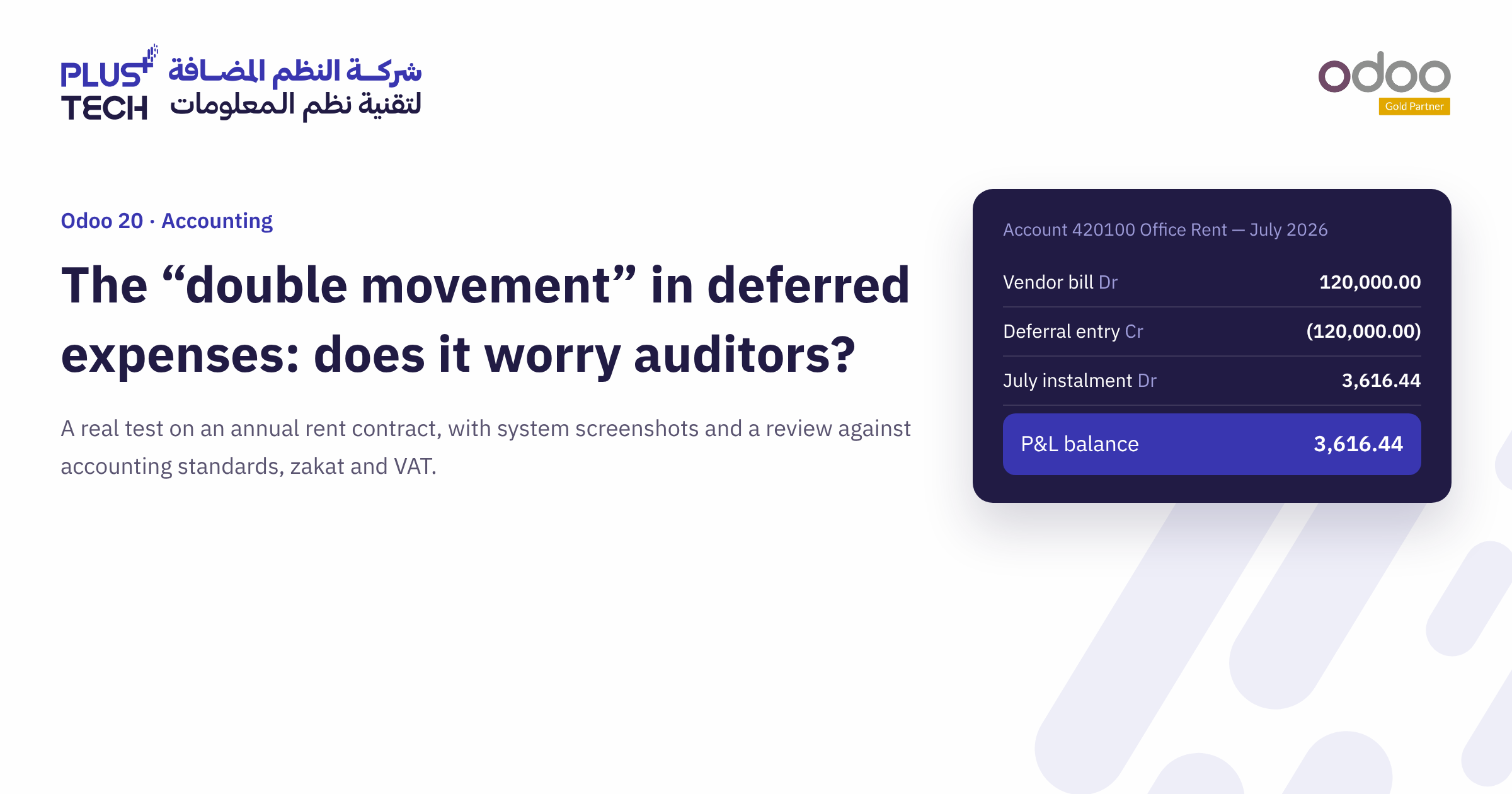
In this article
One of the questions we hear most often from accountants during Odoo implementations is: "Why does the expense account show a debit and a credit for the same amount when we record a prepaid expense? Won't that raise findings from the external auditor or from ZATCA?"
To answer with evidence rather than opinion, we ran the mechanism end to end on a test database in Odoo 20 using an annual rent contract, traced every entry it produced, and reviewed the results against the accounting standards applied in Saudi Arabia and the zakat and VAT requirements.
1. The test scenario
We created a vendor bill for an annual rent contract paid in advance, posted it with Odoo 20's standard settings, and traced every resulting entry through the end of October 2026.
| Environment | Test database — Odoo 20 Enterprise, Saudi chart of accounts |
|---|---|
| Document | Vendor bill BILL/2026/07/0001 — annual rent contract |
| Bill date | 21/07/2026 |
| Service period | 21/07/2026 to 20/07/2027 (365 days) |
| Amount | SAR 120,000.00 + 15% VAT (18,000.00) = SAR 138,000.00 |
| Expense account | 420100 Office Rent |
| Prepaid account | 131500 Prepaid Expenses |
| Deferral settings | Generate entries on bill validation · monthly · computed by days · dedicated "Deferred Expense Entries" journal |
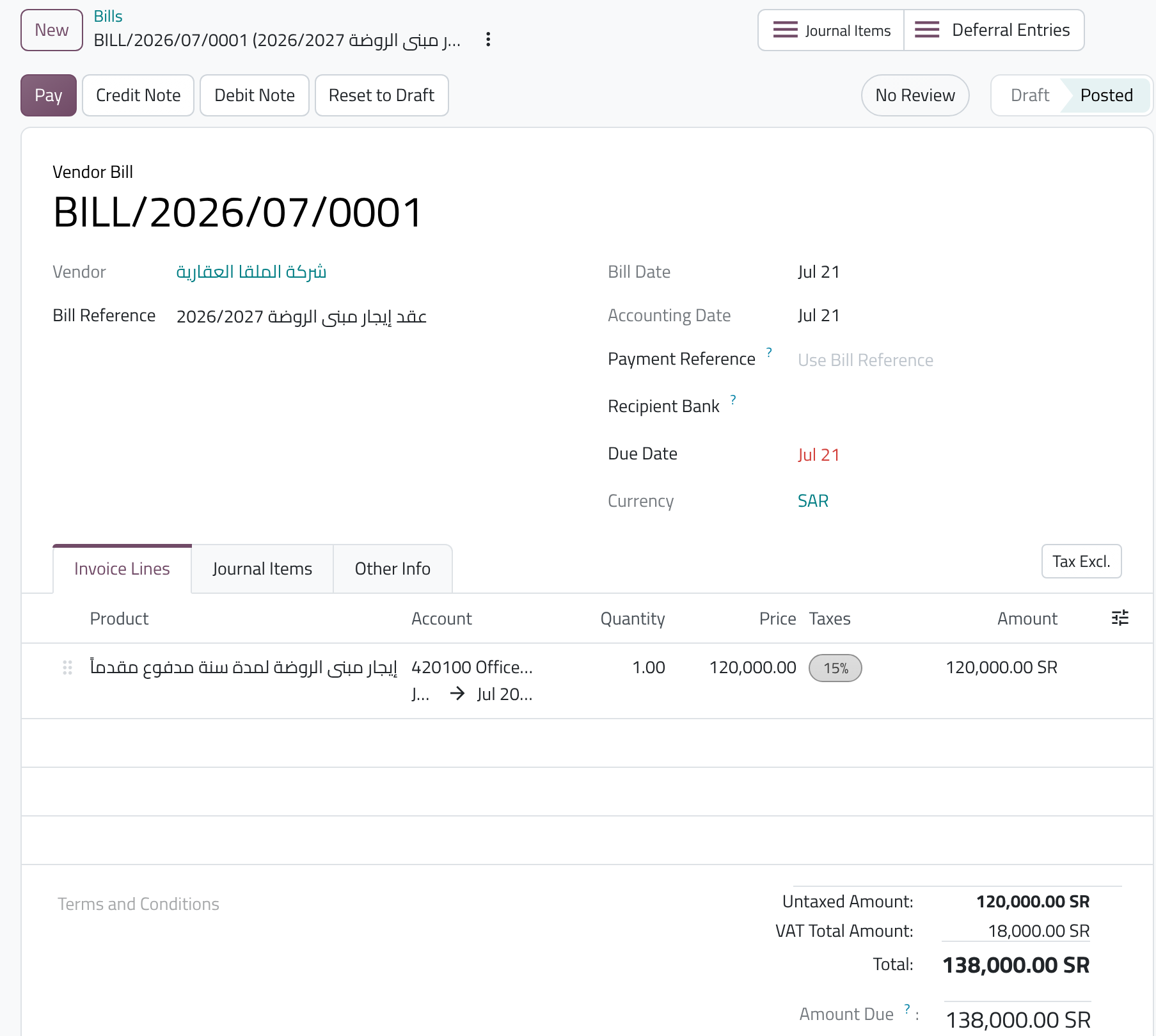
2. How Odoo handles a prepaid expense
Odoo handles a prepaid expense in three consecutive steps: the bill and reclassification entries are posted, while recognition entries for future periods are scheduled to post when due:
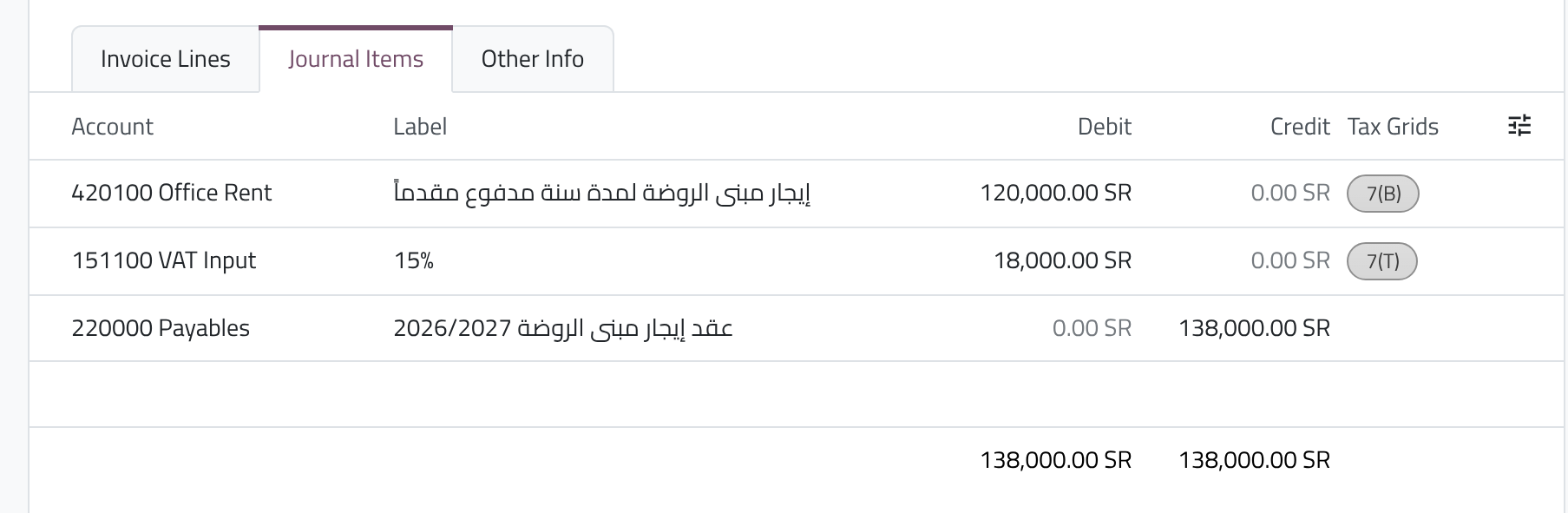
- Bill entry (21/07/2026): debit expense account 420100 with 120,000, debit input VAT with 18,000, and credit payables with 138,000. This is the normal entry for any vendor bill.
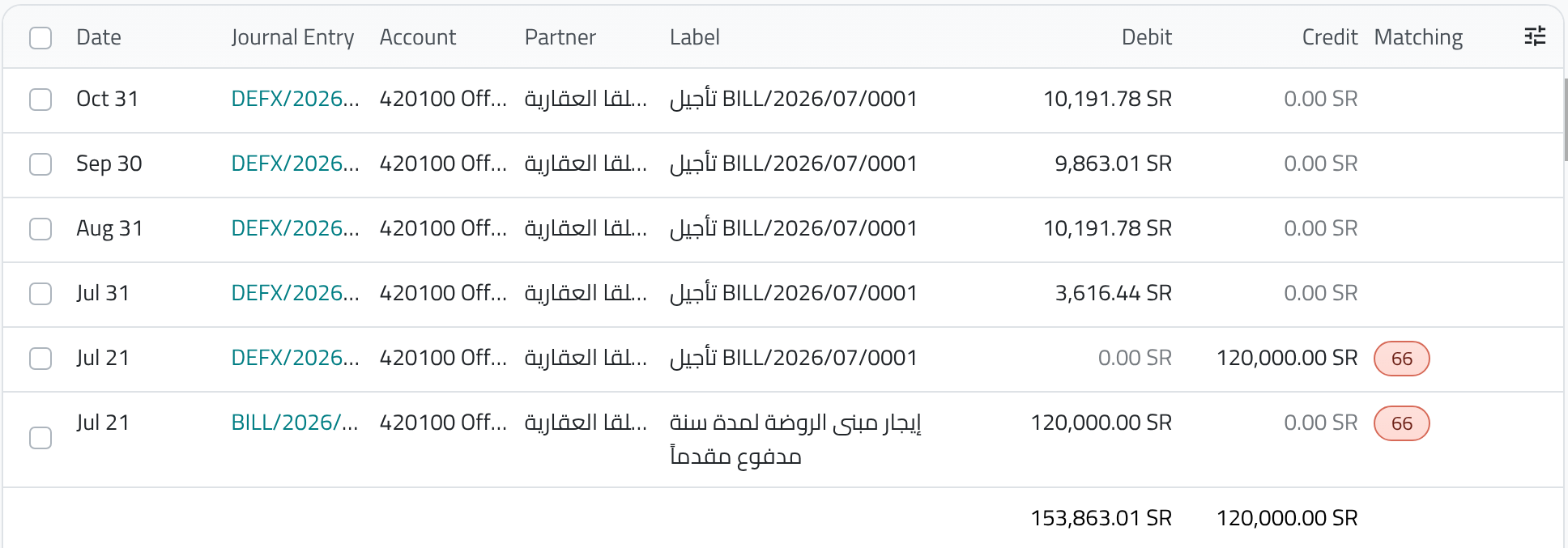
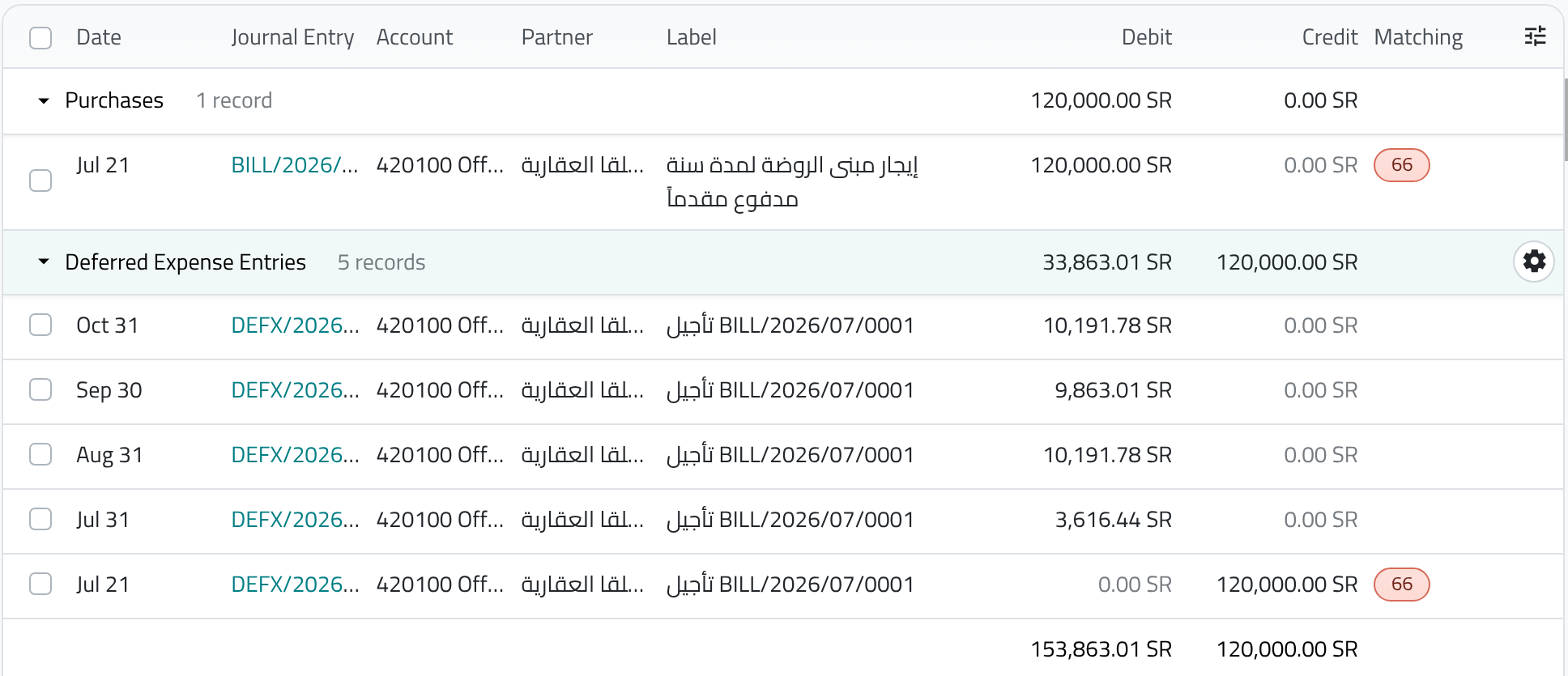
- Deferral entry DEFX/2026/07/0001 (same date): debit 131500 Prepaid Expenses and credit 420100 Office Rent with 120,000. This is a reclassification entry that moves the full amount from the expense to the asset.
- Monthly recognition entries (month end): debit the expense and credit the prepaid account with each month's share: July 3,616.44 (11 days), August 10,191.78 (31 days), and so on until 20/07/2027. Entries for future months are created as drafts that post automatically on their dates, so no period is affected before it arrives.
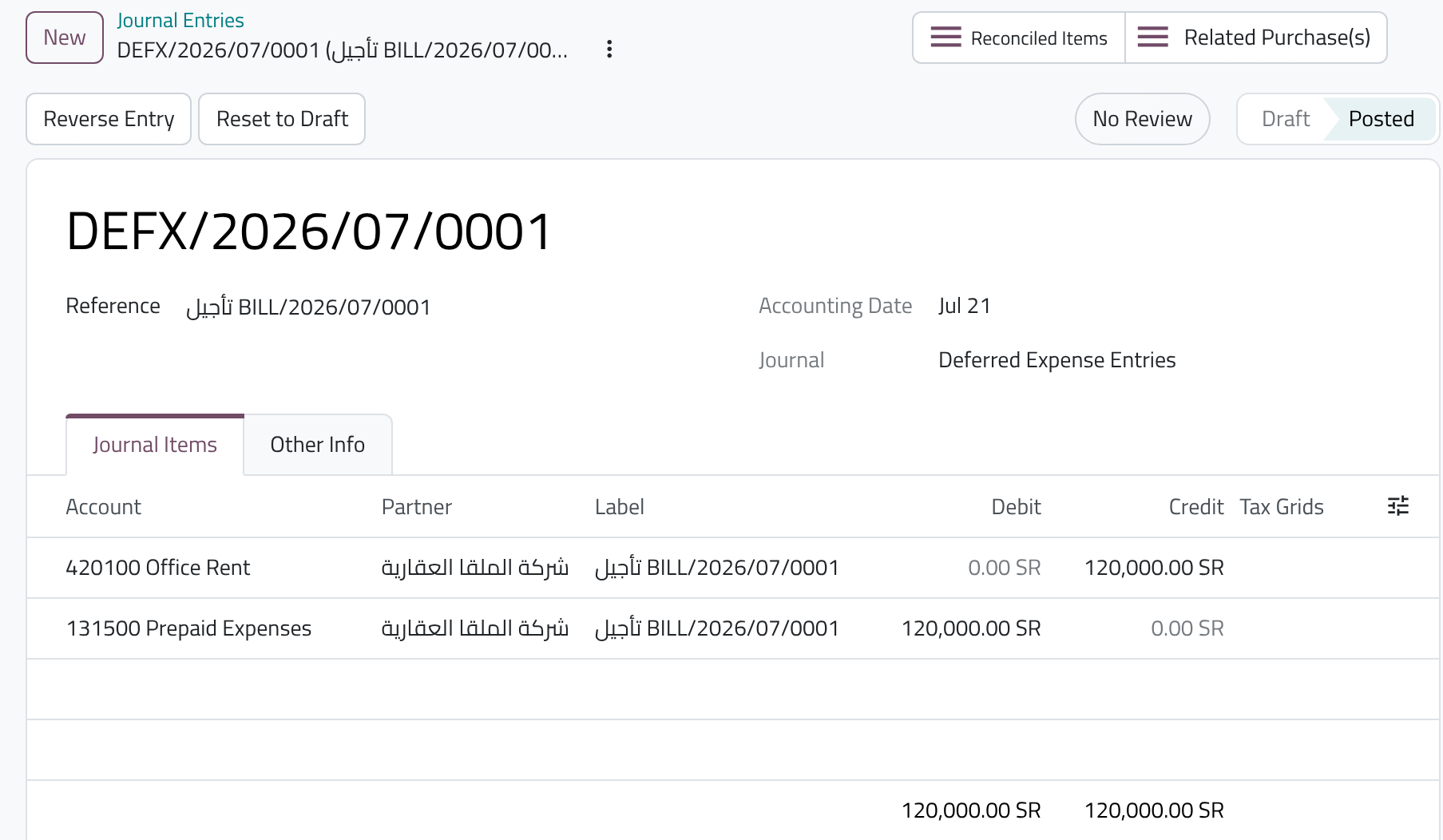
So the "double movement" comes from steps one and two: the expense account shows a debit of 120,000 and a credit of 120,000 on the same day. They offset each other exactly, and the monthly amounts follow.
3. Compared with the traditional approach
In the traditional approach, the bill is posted directly to the prepaid account and the instalments are then recognised monthly, so the amount never passes through the expense account first. The difference between the two approaches is a single reclassification entry; the outcome is identical:
| Item (July 2026) | Traditional | Odoo | Different? |
|---|---|---|---|
| Prepaid balance at 31/07/2026 | 116,383.56 | 116,383.56 | No |
| Rent expense in the income statement | 3,616.44 | 3,616.44 | No |
| Recoverable input VAT | 18,000.00 | 18,000.00 | No |
| Balances used in the zakat base | Identical | Identical | No |
| Link to the source document | Usually manual | Automatic (reference + matching) | Odoo stronger |
| Instalment schedule and recalculation | Manual or recurring entries | Automatic, by days | Odoo more precise |
| Total movement on the expense account in the trial balance | 3,616.44 | 123,616.44 / 120,000 | Yes — presentational only |
Reclassification entries are a familiar tool in accounting and auditing: they are used in period-end adjustments, in classifying expenses and in transferring amounts between accounts. Accounting standards do not prescribe a particular booking path; they require correct recognition, measurement, presentation and disclosure, supported by sufficient appropriate evidence for every balance.
4. How to explain the double movement to the auditor
4.1 The effect of reclassification on the period expense
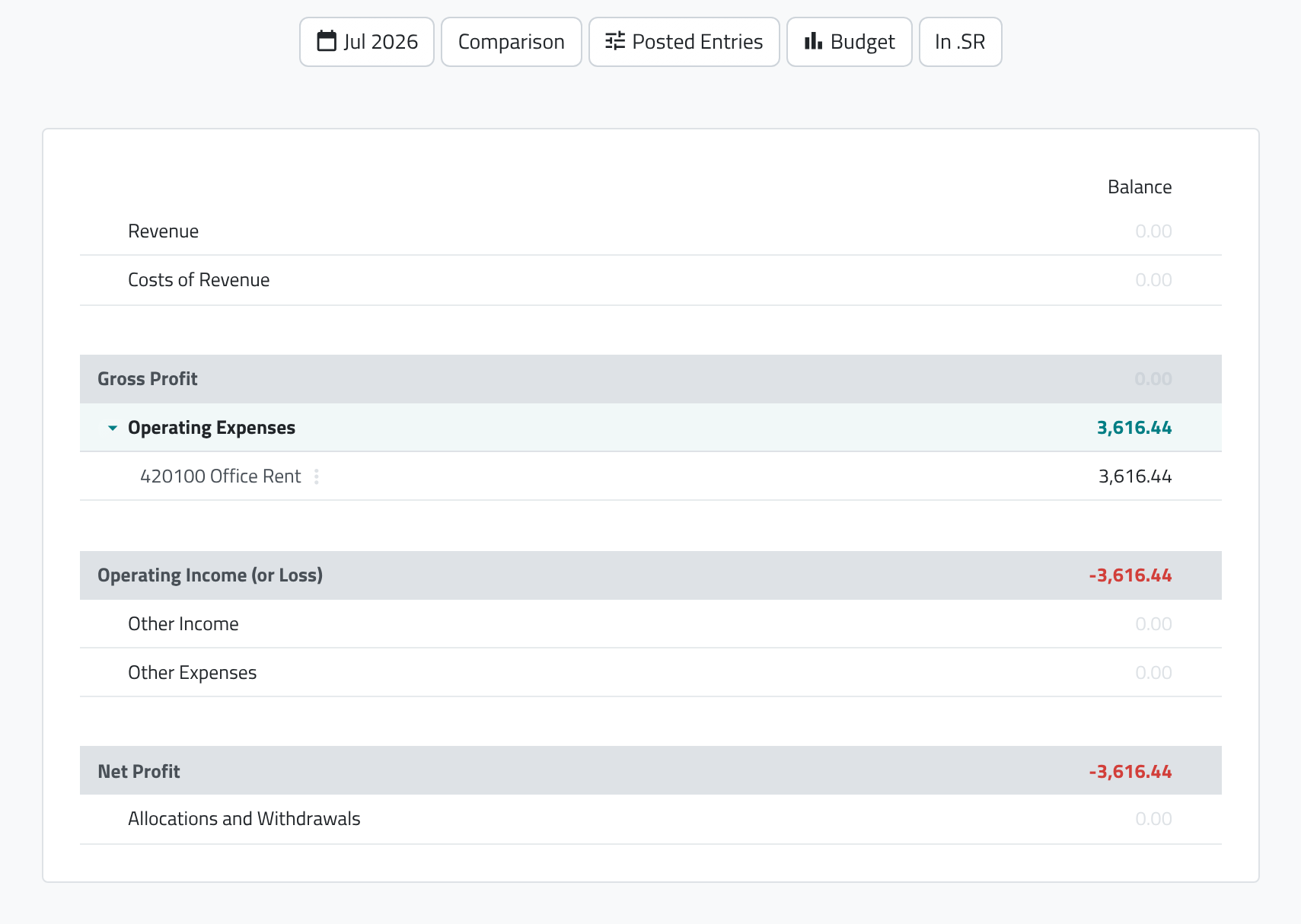
In the example, the income statement for July 2026 shows rent expense of SAR 3,616.44, the period share under the selected computation method. The reclassification adds no net expense because the amount that entered the expense account left it on the same day. The entries, movements and supporting documents remain available for examination and audit.
4.2 The prepaid balance and the zakat review
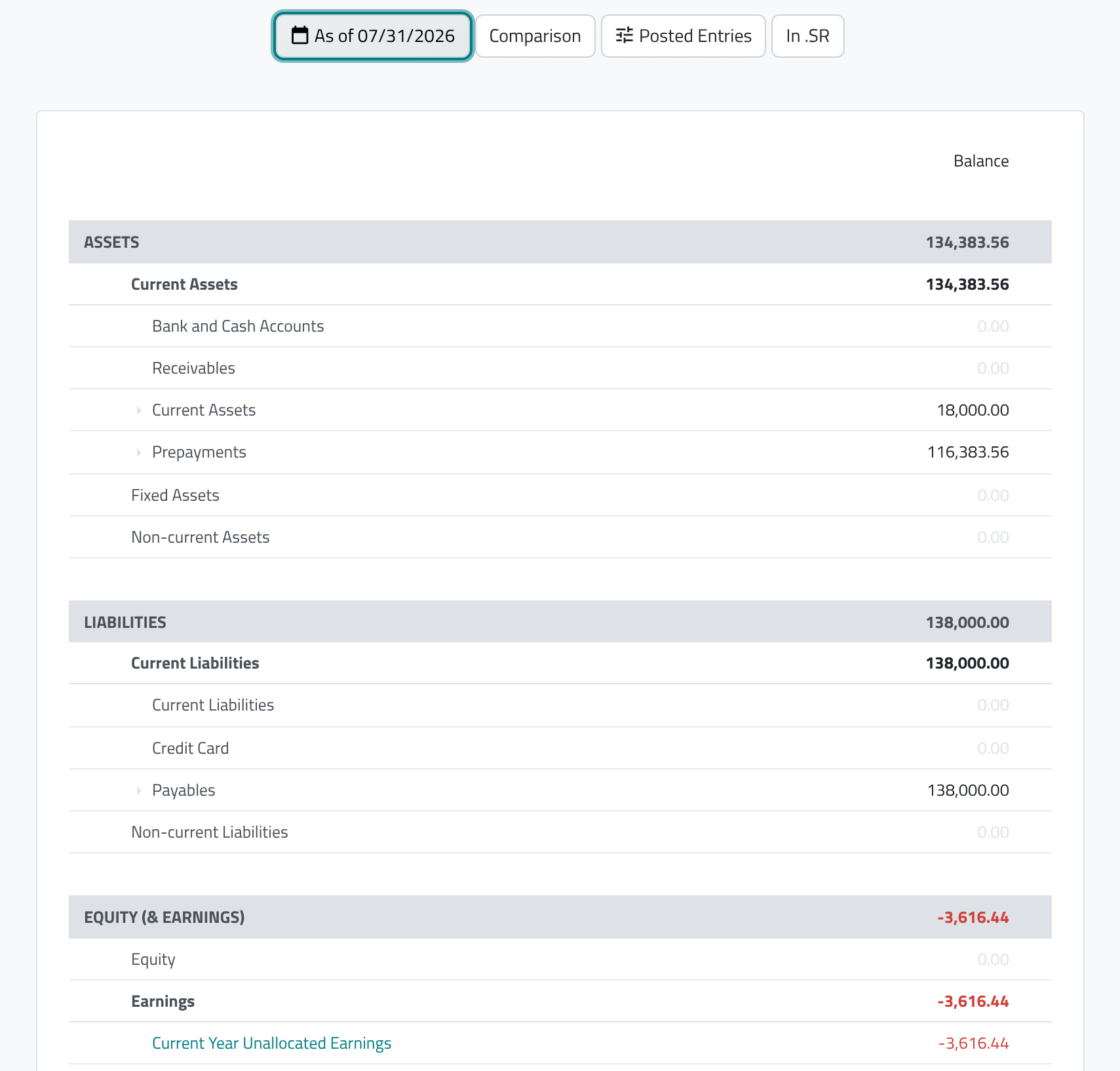
The balance sheet at 31/07/2026 shows prepayments of SAR 116,383.56, the unexpired portion of the contract. In this example, both approaches produce the same balances and result, so the reclassification alone creates no difference in those inputs. Determining the zakat base and required adjustments remains subject to the applicable regulation and the entity’s circumstances.
4.3 Trial balance: the balance is right and the movement is explainable
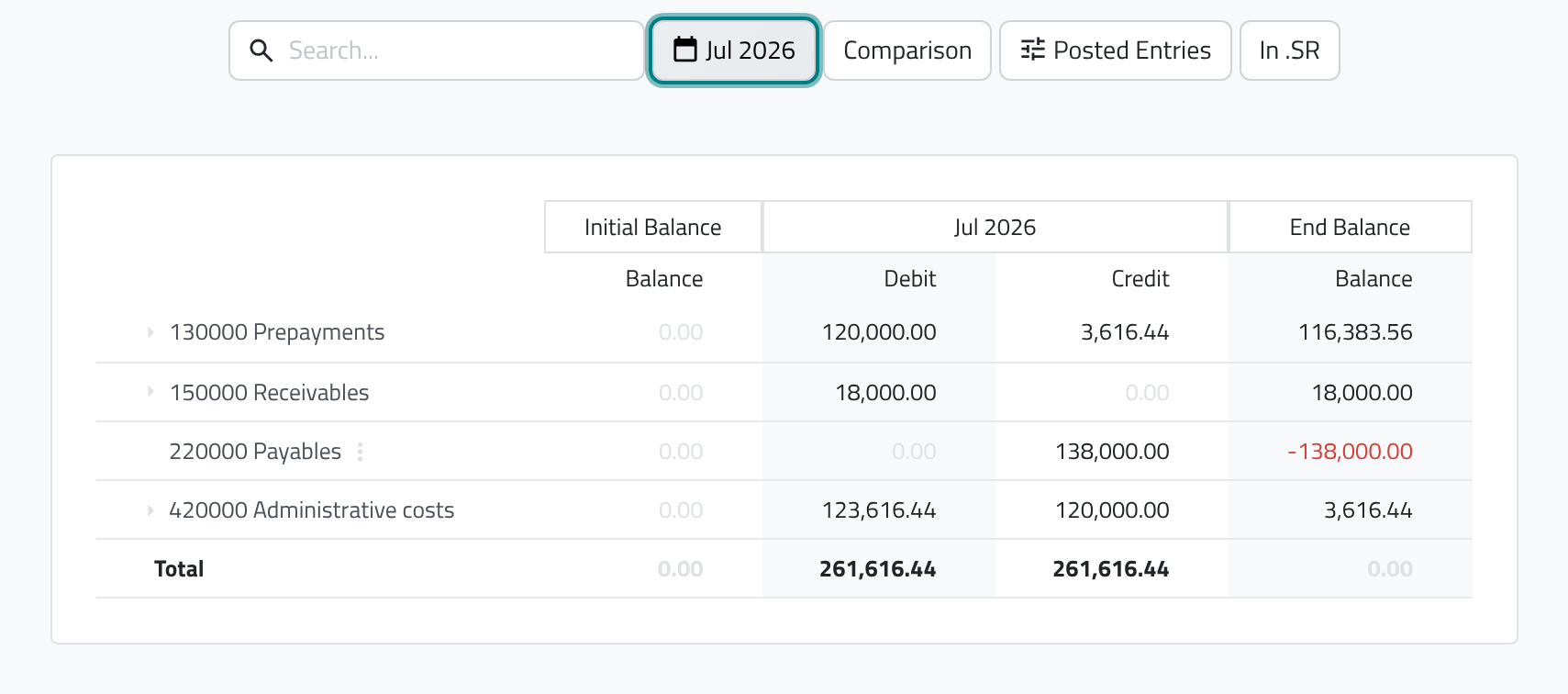
The double movement is visible in the trial balance movement columns and in the general ledger detail: July administrative costs show debits of 123,616.44 and credits of 120,000, with a closing balance of 3,616.44. The auditor can trace the difference to the deferral entry linked to the bill, while also examining journal entries, supporting documents and controls—not only balances.
4.4 A linked audit trail
Auditing standards adopted in Saudi Arabia (ISA 500 Audit Evidence and ISA 230 Audit Documentation) require the auditor to be able to trace every balance back to its source document. Odoo provides this automatically in three ways:
- Reference: every deferral entry carries the bill number BILL/2026/07/0001 in its reference and line labels (Figures 3 and 4).
- Matching: the credit line of the deferral entry is reconciled with the debit line of the bill under a single matching number (66), so they appear as an unambiguous closed pair (Figure 4).
- Two-way navigation: the "Deferral Entries" button on the bill lists every entry it generated, and the "Related Purchase(s)" button on the deferral entry leads back to the bill (Figures 1 and 3).
4.5 A dedicated journal keeps the movement separate
All deferral entries use a dedicated “Deferred Expense Entries” journal with its own sequence (DEFX). Grouping expense movements by journal separates purchases from deferrals. To compare with the traditional approach, prepare a reconciliation that distinguishes the initial reclassification from monthly recognition. Do not exclude the entire deferral journal: it also contains the expense recognised for each period.
4.6 Deferral does not create additional input VAT
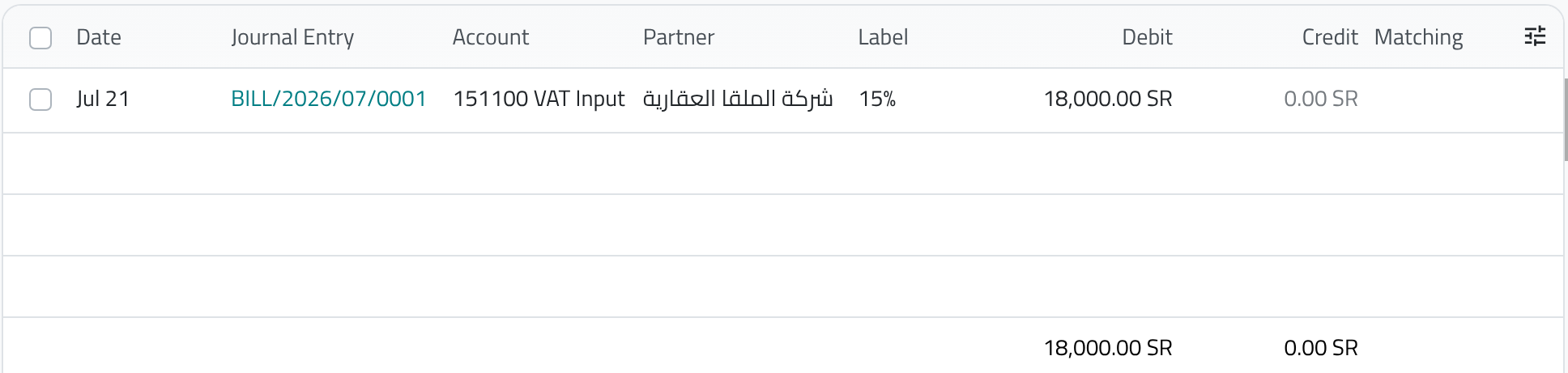
In the example, input VAT of SAR 18,000 was recorded with the bill, while deferral entries contained only expense and prepayment lines, with no additional tax lines. The deferral entry does not determine entitlement to input VAT deduction or its timing. The applicable conditions must be met, including use in taxable economic activity and a valid tax invoice, subject to relevant restrictions.
4.7 Consistent with the accounting framework adopted in Saudi Arabia
Listed entities in Saudi Arabia apply IFRS as endorsed by the Saudi Organization for Chartered and Professional Accountants (SOCPA), while unlisted small and medium-sized entities apply the endorsed IFRS for SMEs and may opt for full IFRS. Under both frameworks:
- The accrual basis is mandatory (IAS 1 paragraphs 27–28, carried over to IAS 8 unchanged in substance when IFRS 18 takes effect; Section 2 of the IFRS for SMEs): the expense is recognised in the period in which the benefit is consumed, which is exactly what the daily instalments achieve.
- A prepayment is an asset because it is a right to future economic benefits, and it is presented within current assets, as Figure 6 shows.
- The standards do not prescribe a specific booking path to reach the balance; they require correct recognition, measurement, presentation and disclosure.
5. The deferred expense report: a subledger for the auditor
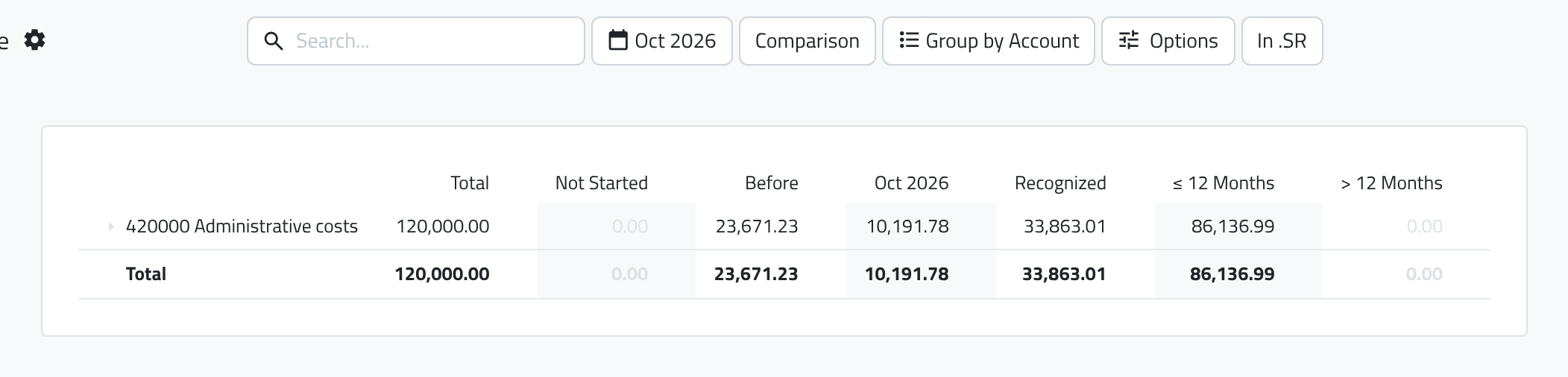
Odoo provides a dedicated Deferred Expense report that works as a subledger for the prepaid account. For each account it shows the total deferred amount, what was recognised before and during the period, and the remaining balance split by maturity. It reconciles directly to account 131500 and can be handed to the auditor at year end together with the reconciliation.
6. Why the computation method matters
The computation method for the instalments is an important setting to review. We tested all three methods available in Odoo on the same contract and compared the expense recognised up to 31/12/2026 with the exact amount (120,000 × 164 ÷ 365 = 53,917.81):
| Computation method | 2026 expense | Difference vs exact | Assessment |
|---|---|---|---|
| By days | 53,917.80 | −0.01 | Exact — recommended |
| By months (first month 10/30) | 53,333.33 | −584.48 | Acceptable; small timing difference |
| Full months | 60,000.00 | +6,082.19 | Not recommended |
The "full months" method charges a full instalment to the starting month even when the contract begins mid-month, which overstates first-year expense. That is the kind of difference that can genuinely catch an auditor's attention, and it is easily avoided through the settings.
7. Recommended settings

- Generate entries on bill validation rather than manually. The manual mode creates a grouped entry at month end and reverses it on the first day of the next month, which means more movement, not less.
- Compute by days with monthly periodicity, and avoid "full months".
- A dedicated journal for deferrals.
- A lock date after each month-end close, so posted entries cannot change.
- Lease contracts: classify the lease before applying the prepayment model. IFRS for SMEs distinguishes operating leases from finance leases, so prepaid-expense treatment does not apply to every contract. Under full IFRS, this treatment may be available if the entity elects the IFRS 16 short-term lease exemption and the contract qualifies: the lease term, after assessing relevant options, is no more than 12 months and the lease has no purchase option. Otherwise, assess the right-of-use asset and lease liability requirements.
- Document the policy in the entity's accounting policies manual with a short paragraph describing the mechanism.
Conclusion
The example shows how Odoo moves an amount from expense to prepayment through a linked, reconciled reclassification entry, then recognises expense over time. The offsetting movement does not mean the expense is duplicated. Reliable results depend on correct accounts, dates and computation settings, reconciled reports, and a review of the contract and applicable zakat and VAT requirements.
All screenshots are from a test database on Odoo 20 Enterprise; the vendor and contract names are fictitious and used for testing only. This article is a technical analysis of the system's mechanism and does not replace the opinion of the entity's external auditor or zakat and tax adviser.
References
1. Odoo — Deferred expenses (official documentation)
2. IFRS Foundation — Use of IFRS Standards in Saudi Arabia
3. IAS Plus (Deloitte) — Saudi Arabia
4. KPMG — IFRS for SMEs, third edition
5. IFRS Foundation — IAS 8 Basis of Preparation of Financial Statements
6. BDO — How does the short-term lease exemption work in IFRS 16?
7. ZATCA — Zakat General Guideline (Zakat Collection 1445H)
8. KPMG Saudi Arabia — New Zakat Implementing Regulation approved
9. IFRS Foundation — IFRS for SMEs, Section 20 Leases
10. IFRS Foundation — IFRS 16 Leases
11. ZATCA — VAT Guideline for Electronic Contracts, Section 8 Input Tax Deduction