Skip to Content

Odoo services in Saudi Arabia · Plus Tech

Odoo Accounting implementation in Saudi Arabia

When a finance director asks where a balance came from, an accountant should be able to trace it to an invoice and a payment. Plus Tech helps finance teams implement Odoo Accounting around the records they actually use: bank statements, customer and supplier invoices, and the trial balance they sign off at close.

What does this solve?

A trial balance can balance while the team still has unanswered questions. Did a customer settle an invoice or pay a deposit against a different order? Was rent charged to the right branch? A migration can also preserve the total due from a customer and lose all the individual due dates. We start with the decisions your team struggles to make today, then agree how much detail Odoo needs to carry forward.

What the work covers

A chart of accounts built for your reports

Review existing accounts and decide which to keep, merge or track by project or cost centre instead. For example, one rent account can feed the general ledger while an agreed allocation splits rent between branches for management reporting.

Opening balances you can still collect and pay

Agree a cutover date and identify unpaid invoices, credits and unallocated payments separately from ledger totals. Compare a customer statement, a supplier statement and the trial balance between systems. A single receivables balance cannot tell your collectors which invoice is overdue.

Receivables and payables by due date

Set payment terms and document references, record a partial payment and test the ageing reports at an agreed date. Collections can then use the list of individual overdue invoices while accounts payable identifies supplier bills that will fall due next.

Bank reconciliation and unexplained differences

Try a representative bank statement and match incoming deposits to the relevant payments or invoices. Distinguish recurring bank fees from unexplained shortages. An accountant should know which conditions a matching rule uses before letting it clear an item.

Branch and project cost reporting

Decide which expenses belong directly to one location and how to split shared costs. Test a supplier bill covering two branches, compare the allocation with your approved basis and confirm that both shares add back to the expense in the general ledger.

A month-end pack the team can explain

Select the reports used at your close meeting, from profit and loss to the balance sheet and trial balance. Trace one figure from a report to the underlying entry and document. Assign responsibility for drafts and outstanding items before sign-off.

How we work with your team

  1. Bring one closed month

    Start with redacted copies of your trial balance, a bank statement, ageing reports and a branch report management uses. Add one awkward case, such as a customer paying several invoices with one transfer.

  2. Approve the account map and cutover plan

    The finance lead agrees the cutover date, reference reports and who can approve differences. Document how much history will move, how open items will be imported and how the team will consult older records.

  3. Rehearse a transaction from invoice to bank

    Have an accountant issue an invoice, identify its bank receipt and then process a credit note or part payment. Compare the customer's open items with the control account at the same reporting date.

  4. Run the first close with named owners

    Assign someone to investigate unmatched bank items, someone to review unposted invoices and someone to approve the report pack. Keep an exceptions list showing the person responsible for each difference and the next action.

Inside Odoo Accounting

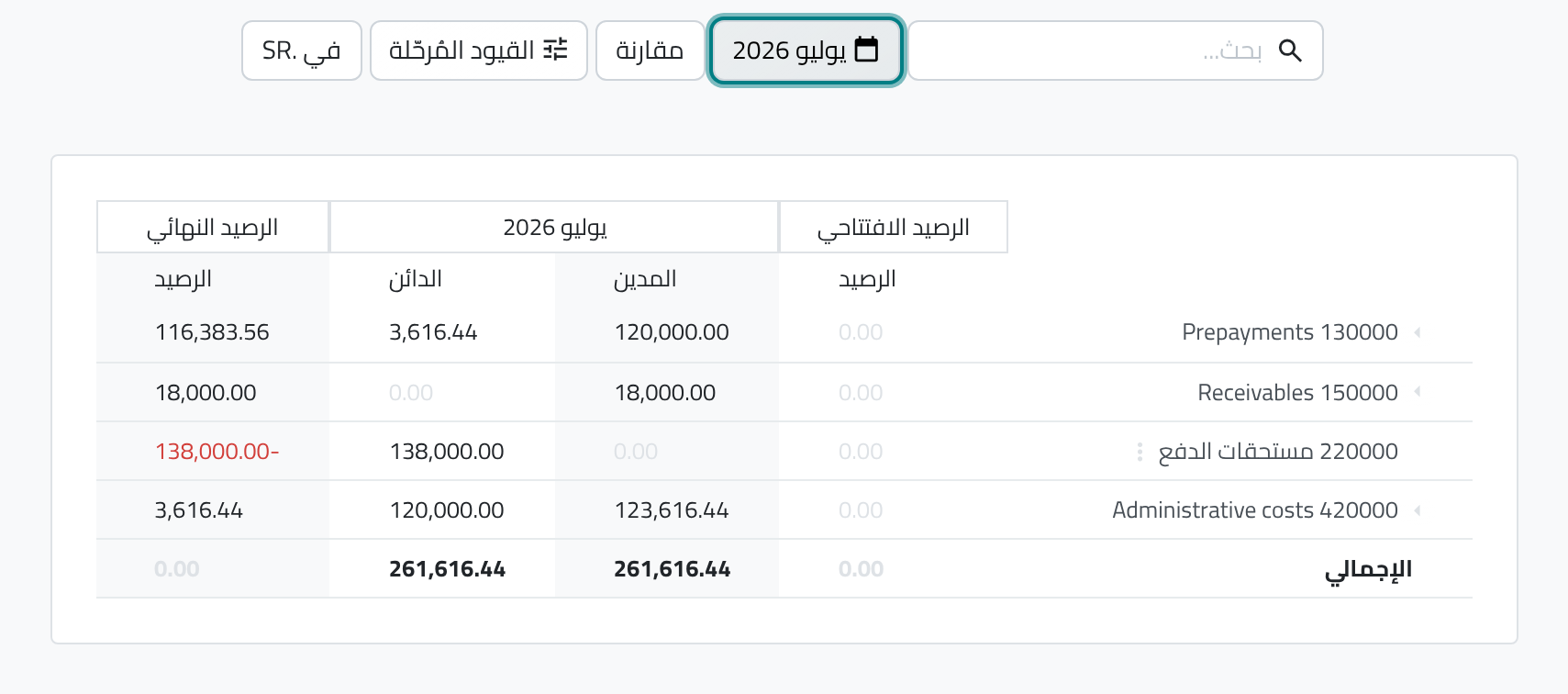
An Arabic Odoo trial balance showing opening balances, debit and credit movements and closing balances
A trial balance from Plus Tech’s published deferred-expense test. July debits and credits match, with account movements available for review.
Arabic Odoo Accounting settings for deferred expenses and revenues
Settings from the same test environment showing the journal, account and frequency for deferral entries.

Questions before you start

Do we have to migrate every historical entry?

That depends on how people consult your history. One option is to bring opening balances and open documents into Odoo while retaining read access to the former system. If detailed monthly comparisons must run inside Odoo, include the additional history and reconciliation work in scope.

Does every branch need a separate chart of accounts?

First distinguish a branch of the same entity from a company keeping separate books. If management only needs cost allocations within one entity, analytic accounts may be enough. Test the decision against one real branch report before applying it everywhere.

What if our bank has no direct connection?

Bank transaction files and manual entry are alternatives to a supported direct feed. Try a sample file from your bank. Its dates, descriptions, amounts and references need to be usable for both the import and the matching work afterwards.

What about Saudi e-invoicing?

Odoo provides a Saudi fiscal localization. Scope the relevant invoices, credit notes and any point-of-sale flows, then test the required issuance scenarios for your configuration. The work depends on your entity and software version; your finance owner approves the chosen treatment.

What should we bring for a project estimate?

List your entities, users, bank accounts and open-document volumes. Include special reports and external systems involved. Five years of transaction-level history takes different preparation and testing from a move based chiefly on opening balances.

Book a demo

Leave your details and a Plus Tech consultant will contact you within one business day.

We use your details to follow up on this request. Privacy policy

Book a free demo

+966 57 745 4545

Further reading